

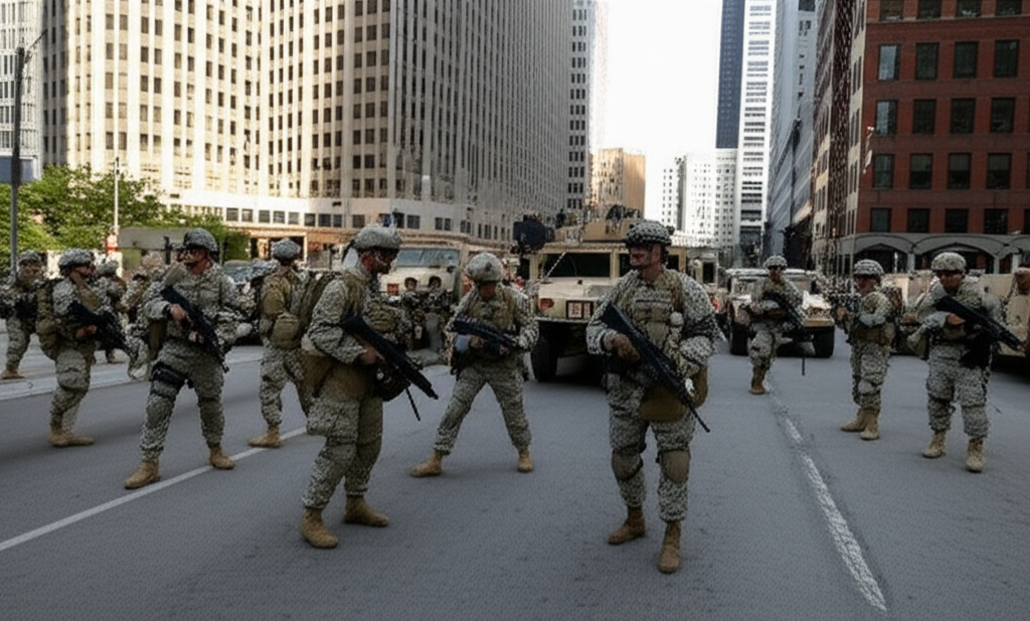
The Pentagon’s Quiet Shift: Building 500-Troop Quick Reaction Forces Nationwide ⚔️
In the shadowy corridors of power, where defense budgets flow like water and decisions ripple into the future, the Pentagon is devising a strategy that resembles both an ambitious chess maneuver and a tactical flash—a plan to deploy 500-troop quick reaction forces in all 50 states. This development, shrouded in subtlety yet pulsating with potential ramifications, raises a question that gnaws at the fabric of national security: why? 🧐
Building Forces: A Shield or a Sword? 🛡️
In an era where looming threats can emerge as ferociously as summer storms, the Pentagon’s intention to establish these rapid-response units might be perceived as a preemptive strike against chaos—as if deploying a military umbrella over the vulnerable fabric of American society. The irony of this move lies not only in its ambition but in the dual-edged dichotomy it poses: does it fortify local defense, or does it hint at an unsettling shift towards militarization within civilian spaces?
This rhetoric is laced with an intriguing complexity. The contradiction thrives in the idea that a robust military presence could both enhance security and evoke fear—a reminder that history has seen armies treated as guardians and, at times, as occupiers. The establishment of these 500-troop contingents—complete with their ominous gear and poised readiness—sounds an air horn of sorts. A loud signal to both allies and adversaries that the United States is prepared to respond swiftly to unexpected challenges. But could this be overkill dressed in tactical garb?
From Global to Local: A Strategic Pivot
In shifting its focus from global theaters to localized readiness, the Pentagon seems to read the proverbial tea leaves, predicting that threats to national security may no longer come from afar, but rather from localized unrest, natural disasters, or domestic emergencies 🌪️. The pandemic served as a grim reminder that crises can arise without warning, reshaping our understanding of “quick reaction.” Michael Haydon, a former intelligence officer, noted that this “growing trend of militarizing our immediate surroundings” could reshape civilian life in profound ways.
“We must be ready for everything—whether it’s violent clashes on the streets or the aftermath of a natural disaster,” Haydon explained.
However, this shift also invites skepticism, as security practices become aligned with preemptive military strategies. The juxtaposition of a potent, responsive force stationed in every state against the ideal of civilian autonomy raises concerns over a security state, teetering on the edge between protection and infringement of liberties. Are these troops meant to shield us, or are they encroaching upon our freedoms?
The Irony of Readiness: A Question of Trust 🔍
The deployment of these forces, presented as a benevolent measure, could just as succinctly be viewed through the lens of irony: the very people they are meant to protect might feel trapped under the watchful eye of a growing military presence. The irony of seeking security through potential intimidation is not lost on observers. The historical parallel can be drawn to regimes that have flourished under the guise of protection, cloaking their moves in the fabric of security while stifling dissent.
This striking contrast reveals a deeper philosophical conundrum: how do we reconcile our yearning for safety with the fundamental tenets of freedom? Some may argue that a rapid-response force provides a necessary buffer against chaos, but what of our trust in such forces to wield their power responsibly? The very fabric of democracy is woven from the strands of military respect and civilian oversight—can we afford to risk fraying those threads?
Implications for Local Communities 🏙️
The presence of these quick reaction forces across the country will unavoidably impact local communities, merging the lines of civilian life and military duty. The question arises: can we imagine a community in which a 500-troop garrison becomes a feature of daily life? Picture soldiers at community events, disaster preparedness training, and emergency drills—concurrently guardians and guests. For some, this will be a welcome pivot towards safety; for others, a stark reminder that the fortress might just be both a comfort and a cage.
As local leaders navigate this multifaceted reality, striking the proper balance between community engagement and defense readiness will be crucial. Will residents embrace the newfound security or question its authenticity, peering through the barbed wire with wariness? This dance of diplomacy between military presence and community trust becomes vital.💭
Looking Ahead: The Challenge of Adaptation🔮
As the Pentagon develops these rapid response units, the task ahead is to cultivate a mutual understanding between armed forces and civilian populations. The challenge will lie in ensuring that this strategy—this ‘quick reaction force’ narrative—does not purely revolve around the muscle of military might, but instead fosters a culture of collaboration and respect.
A melding of skills might emerge, where service members are trained not just in combat, but as advocates for community resilience, disaster response, and public outreach. Perhaps, instead of merely reacting quickly to threats, these forces could become agents of proactive peace—fostering dialogue where conflict could brew. Can we envision them not just as protectors against danger but as cultivators of trust? 🌱
In a nation bearing the scars of division, a renewed military commitment to local communities could mend or further sever our social fabric, depending on how it’s wielded. The Pentagon is at a crossroads, standing at the confluence of legislative intent and public perception. The success of this ambitious program hinges on its ability to remain nimble, not merely adapting to threats, but also to the evolving unifying narrative of America’s diverse communities.
As the drums of military readiness echo through the states, the unyielding question remains: will these forces become bastions of safety, or harbingers of a militarized landscape? Perhaps, only time will reveal the true nature of this strategic pivot, caught in the dual light of necessity and irony. 🌍
Can we trust the Pentagons move to build 500-troop forces in every state? Is it a shield or a sword? Lets discuss! 🛡️⚔️
Cant decide if this move is a shield or a sword 🤔 What do you think – smart strategy or unnecessary risk? 🛡️⚔️
Is this a step towards security or escalating tensions? Are we prepared or provoking conflict? 🤔 #DefenseDebate
500 troops in every state? Bold move or overreach? Discussing the balance between defense and militarization. Thoughts? 🤔🛡️⚔️
Is the Pentagons move a strategic pivot or a questionable trust exercise? Lets discuss the implications. 🤔 #militarystrategy #nationaldefense
Is this a smart move or overkill? 🤔 Are we building defenses or preparing for conflict? Share your thoughts! 🗣️