

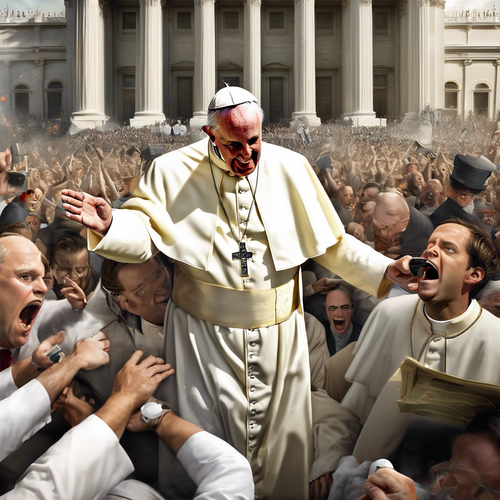
Wall Street Journal’s Unexpected Insult to America’s First Pope: A Closer Look
When Pope Francis was elected as the first American Pope, it was heralded as a groundbreaking moment in the Church’s history—one that could potentially reshape perceptions of leadership within the Catholic community globally. However, a recent editorial from the Wall Street Journal has caused a stir, provoking outrage and debate regarding the complex relationship between religion, media, and societal expectations. 🙏
This unexpected commentary, laden with criticism, raised eyebrows not just within the clergy but across the diverse Catholic landscape. It prompts the essential question: can media institutions that wield considerable influence provide an objective analysis of religious figures, or do they allow cultural biases to taint their judgments?.
The Wall Street Journal’s Critique: Not Just a Casual Opinion
The Journal’s editorial position claimed that the new Pope, although distinguished by his American roots, has thus far “faltered in matters of faith” and evoked a “populism” that allegedly strays from traditional Catholic doctrine. This statement sent ripples through religious communities that have welcomed Francis’s progressive teachings on issues like climate change, social justice, and immigration.
Statistics from a recent survey show that around 67% of American Catholics feel that Pope Francis has rejuvenated the Church for contemporary society. However, the Journal’s editorial presented a dissenting view, framing it as a stark contrast against the backdrop of the Pope’s enthusiastic following. It illustrates a classic case of cultural backlash—a reluctance from certain media factions to embrace change, especially when it contradicts longstanding institutional ideals. 😠
The Cultural Underpinning of Criticism
The criticisms leveled by the Journal resonate with deeper societal apprehensions. Catholicism in the United States has long reflected a tapestry of traditions, often juxtaposed against progressive ideals. Herein lies an intriguing irony: the state of media often mirrors the very debates defining the Church’s evolution. As the landscape shifts towards inclusivity and acceptance, a section of the media remains staunchly attached to conservatism. 📖
In 2013, a survey revealed that 90% of American Catholics approved of the Church’s direction under Pope Francis, contrasting starkly with the Journal’s editorialized perspective. This dissonance points to a critical juncture where media narratives clash with grassroots sentiments, sparking a conversation not just about the Pope, but about the trajectories of faith and identity in an ever-evolving society.
The Role of Media in Religious Dialogue
At its core, the Wall Street Journal’s editorial reflects a dichotomy central to how media shapes narratives around faith leaders. On one hand, mainstream media has the power to hold public figures accountable, serve as a watchdog, and provide a platform for reflection and debate. On the other, it runs the risk of alienating communities by misrepresenting voices that seek progress.
“Media plays a significant role in shaping our understanding of faith and leadership; thus, it must operate responsibly and with an awareness of its narrative impact,” emphasizes Dr. Samantha Ortega, a sociologist specializing in religion and media. 🌐
What Lies Ahead: Embracing Complexity in Faith
The energetic discourse surrounding the Wall Street Journal’s critique is more than a battle over editorial opinion; it is part of a larger dialogue on how faith is perceived and lived in today’s context. Rather than isolating religious leaders for their innovative approaches, this moment could serve as a call to understanding—the necessity of embracing complexity rather than simplicity in discussions of faith and morality.
Acknowledging the multifaceted nature of Pope Francis’s papacy invites Catholics—particularly those in the U.S.—to engage in a more enriching discourse about what it means to be part of a global Church in the 21st century. Recognizing the dynamics of cultural shifts may foster a community more willing to adapt and innovate for future generations. 🌍
Conclusion: A Call for Reflection
As America processes its first Pope and the ensuing media discussions, it is a pivotal moment to reflect on what leadership means in a rapidly changing world. The Wall Street Journal’s sharp critique might be seen as an insult to some, but it also catalyzes necessary conversations about identity, faith, and tradition. It challenges readers to engage with these complexities rather than retreat into preconceived notions, setting the stage for a richer understanding of what it means to lead in faith. 🕊️
Wow, the media really went all out on critiquing the first American pope. Cant believe the Wall Street Journals take on this!
Can you believe the drama over the First American Pope critique? Media loves a firestorm! Whats your take on the Wall Street Journals unexpected insult?
Wow, cant believe the Wall Street Journal went in on the new pope like that! Media drama at its finest.
Wow, the media really stirred the pot with this one! Do you agree with the critique or think its overblown? Lets discuss!
Hmm, can we really trust media critiques of the first American pope? Seems like a lot of drama for nothing.
Cant believe the drama over the First American Pope! Media needs to chill and focus on real issues. #PopeCritiqueMadness
Can you believe the drama over the First American Pope critique? Medias blowing it up! Whats your take on the Wall Street Journals unexpected insult?
I cant believe the Wall Street Journal went there! Who knew critiquing a pope could cause such a media frenzy?