

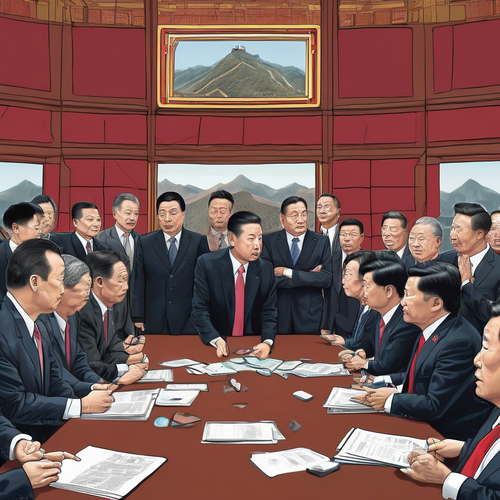
Beijing’s Strategic Calculus: Fentanyl Offer as a Lever in U.S. Trade Talks
In a striking move that intertwines international diplomacy with a public health crisis, Beijing is reportedly considering extending a controversial offer to restrict fentanyl production as leverage in its strained trade negotiations with the United States. This intriguing tactic raises profound questions: Can the U.S. curb its ongoing opioid epidemic while also addressing the broader dynamics of the U.S.-China economic relationship? 🌏💼
The backdrop is stark. Fentanyl, a synthetic opioid that is up to 50 times more potent than heroin, has become a leading cause of drug overdoses in the U.S., claiming tens of thousands of lives annually. The Centers for Disease Control and Prevention (CDC) has reported that synthetic opioids, predominantly fentanyl, were involved in nearly 70% of all opioid overdose deaths in 2021 alone. It is within this context of urgency that Beijing’s proposal comes into play.
Trade Tensions and Tactical Moves
U.S.-China relations have soured significantly over trade imbalances, human rights concerns, and technological competition. Under these circumstances, Beijing’s willingness to use fentanyl as a bargaining chip is both significant and alarming. According to a recent analysis, the illicit production of this drug has accelerated in China’s clandestine labs, leading to severe economic and social ramifications in the United States.
“Offering to curtail the production of fentanyl could be Beijing’s attempt to reframe the narrative around the trade discussions,” explains Dr. Lisa Chen, a political analyst at the Brookings Institution. “It presents an opportunity for China to position itself as a cooperative player in the fight against drug addiction, which has been largely perceived as a crisis exacerbated by Chinese exports.”
The Fentanyl Crisis: A Double-Edged Sword
Fentanyl’s dual role as both a commodity and a public menace complicates negotiations. Additional statistics reveal that in 2020, synthetic opioid deaths soared to over 56,000, indicating a staggering 38.4% increase from the previous year. This growing crisis is pushing the U.S. government to take a more aggressive stance against narcotic imports.
However, imposing stricter trade barriers against China could lead to retaliation and further escalate an already volatile economic environment. Analysts suggest that the U.S. must tread carefully, balancing tough rhetoric with the need for constructive dialogue. “Security issues, particularly related to drug trafficking, could easily tailspin into greater economic tensions if not handled adeptly,” notes Dr. Brian O’Malley, an expert on global trade.
Negotiation or Manipulation? The Fine Line
Is Beijing genuinely interested in curtailing the fentanyl trade, or is this merely a tactical maneuver to ease trade sanctions? Some experts speculate that this is a calculated move designed to sway American public opinion and soften U.S. opposition on other contentious issues such as tariffs on Chinese goods.
“Trade negotiations should ideally focus on mutual benefit, but when public health enters the fray, it complicates motivations and alliances. The question remains: will the U.S. see this offer as a genuine gesture and reply with goodwill?”
The implications extend beyond economics; they seep into the fabric of U.S. domestic politics. With midterm elections looming, how President Biden and his administration handle the fentanyl dilemma can greatly influence voter sentiment, especially among communities ravaged by the opioid epidemic. 🗳️
Path Forward: A Complex Web of Interdependence
As discussions unfold, both nations must recognize that their fates are intertwined. The U.S. could begin to implement stricter domestic policies focusing on drug education, rehabilitation, and prevention, while simultaneously engaging in dialogues with China to address the underlying issues stemming from illicit drug production. Ensuring a collaborative approach that delves into the root causes and complexities of the fentanyl crisis may yield productive outcomes for both nations.
Ultimately, the offer from Beijing to cap fentanyl production may represent an opening for meaningful dialogue, but it also underscores the stakes involved. This delicate balancing act between economic negotiation and humanitarian concern reminds us that in the realm of international relations, every move has far-reaching consequences. 📉🌐
The coming months will be critical as Beijing and Washington navigate this intricate spider web of politics, health, and trade. Will a promise to stem the flow of lethal opioids alter the trajectory of bilateral ties, or will it be just another fleeting gesture in a complicated history? Only time will tell.
I find it intriguing how Beijing is using fentanyl as a bargaining chip in trade talks. Smart strategy or unethical manipulation? Lets discuss!
Do you think Beijings use of fentanyl in trade talks is a smart tactic or a dangerous game? Lets discuss!
Do you think Beijings use of fentanyl as a bargaining chip in trade talks is strategic or manipulative? Lets discuss!
Do you think Beijings use of fentanyl in trade talks is strategic or manipulative? Im torn between the two perspectives.
Do you think Beijings use of fentanyl as a bargaining chip in trade talks is ethical or manipulative? Lets discuss!
Do you think using fentanyl as a bargaining chip is justified or manipulative in trade negotiations? Lets discuss!
Isnt it crazy how fentanyl is being used as a bargaining chip in trade talks? Manipulation or negotiation, whats your take?
Fentanyl should never be used as a bargaining chip. Its a matter of ethics, not negotiation.
What if Beijings fentanyl offer is just a strategic ploy to gain leverage in trade talks? Manipulation or negotiation, what do you think?
Is Beijings fentanyl offer a genuine negotiation tactic or just manipulation? The fine line is blurred, lets discuss!