

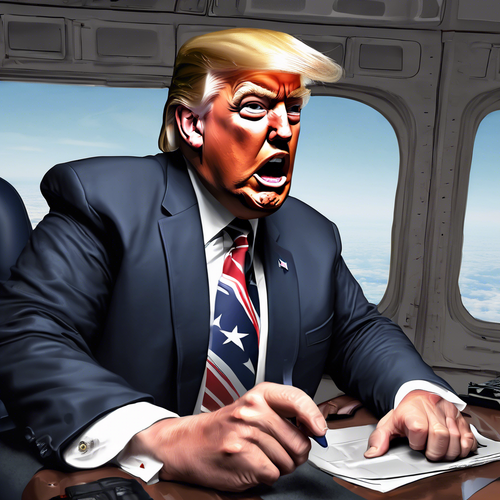
‘You Hear Me? What I Said?’: Trump Loses Temper with Reporter on Air Force One
In a striking display of frustration aboard Air Force One, former President Donald Trump faced off against reporters during a post-press conference flight. Witnesses described the atmosphere on the presidential aircraft as nothing short of explosive, with Trump’s temper flaring over a line of questioning that he deemed inappropriate. “You hear me? What I said?” he shouted, directing his ire at a reporter who persistently sought clarification on his administration’s recent policies.
This incident not only underscores Trump’s well-documented contentious relationship with the media but also illustrates the ongoing tensions that characterized his presidency. Even after leaving office, Trump’s confrontations with the press remain a focal point of his public persona, energizing both his supporters and detractors. The Air Force One encounter serves as a vivid reminder of the intricate dance between the presidency and the Fourth Estate, a dynamic that has shaped American politics for generations.
The Tensions of the Trump Era
Throughout his presidency, Trump often accused the mainstream media of “fake news,” leading to an adversarial relationship. With frequent tirades against reporters, he transformed press briefings into battlegrounds rather than forums for dialogue. Statistics show that during his term, the frequency of contentious exchanges increased, reflecting a growing discomfort between the press and the executive. In fact, numerous reports indicated that notable press conferences spiraled into shouting matches, defined by personal attacks and abrupt dismissals of questions. 😡
Trump’s rhetoric resonates deeply with his base, who often express distrust toward traditional media. In a 2020 Gallup poll, only 41% of Americans said they had a “great deal” or “fair amount” of trust in the media, a stark contrast to the 72% who said the same in 1976. This evolution represents a significant shift in public perception, promoting a polarized media landscape that some argue poses serious risks to democratic discourse.
A Closer Look at the Air Force One Confrontation
As cameras clicked away, the confrontation unfolded with palpable tension. After a question regarding the administration’s approach to foreign relations, Trump snapped, demanding the reporter repeat the question as though validity was contingent on insistence. The moment captured the essence of his combative approach to media engagement — an unyielding stance that thrives on confrontation rather than dialogue. 📸
This particular incident raises crucial questions about accountability in politics, especially regarding the president’s obligation to address the public through the media. Historically, American leaders have relied on journalists to convey their messages and engage constructively with citizens. Yet, in an age of misinformation and division, Trump’s tactics reflect a disheartening departure from these traditions, forcing a reevaluation of the roles both politicians and the press play in our democratic framework.
The Aftermath: Implications for Media Relations
In rolling reports post-incident, analysts noted that reactions varied widely. Supporters applauded Trump’s unwavering assertiveness, viewing it as a necessary defense against what they perceived as biased questioning. Conversely, critics saw this outburst as emblematic of a disconnection from the principles of transparency and respect the media strives to maintain. “As president, Trump was expected to embody a level of accountability that comes with leadership,” reflected Dr. Sarah Tinsley, a media expert at the University of Maryland. “Instead, these flashes of aggression severely blurred the lines of respectable governance.”
“When leaders lose their tempers, it reveals insecurities; they interrupt the necessary checks that democracy demands,” stated Dr. John Munroe, political science professor. “The media are not the enemies; they are the conduits of democracy.” 🔍
Looking Forward: The Future of Media and Politics
The Air Force One incident serves as a stark reminder of the volatile landscape that defines contemporary politics. The relationship between the presidency and the media will undoubtedly continue to evolve as new leaders emerge, but the lessons learned from Trump’s confrontations cannot be ignored. As journalism grapples with its role in this new era, fostering trust will be vital in restoring the public’s confidence in both the media and their elected officials.
In the aftermath of the confrontation, discussions have arisen regarding the protocol and accessibility of journalists in covering the presidency. How can future administrations navigate these tensions while maintaining an open line of communication with the public? One thing remains clear: the success of American democracy hinges on informed citizens — and that requires a press that feels empowered, respected, and able to hold power to account. 🗞️
I think Trumps behavior on Air Force One shows his lack of respect for the press. Media relations are crucial for transparency.
I cant believe Trumps outburst on Air Force One! Do you think he was justified or totally out of line? Lets discuss!